
The underestimated problem is not making plastic lighter
The low-altitude economy does not create one new plastics market. It creates several material environments at once: agricultural drones that see chemicals and sunlight; inspection aircraft that launch in winter; logistics systems that cycle batteries and connectors; charging cabinets, communication modules and vertiport equipment that remain outdoors; and passenger-carrying eVTOL concepts that face a much higher certification burden. A material suitable for one of these environments is not automatically suitable for the others.
Weight still matters because every gram competes with payload and range. But replacing aluminium with a polymer is the beginning of the engineering problem, not the end. A thin moulded enclosure may be lighter yet become more vulnerable to impact, creep, warpage, electromagnetic leakage, surface tracking or fire. A formulation that improves one weakness can expose another. More flame retardant can reduce toughness or flow; more elastomer can lower stiffness and heat resistance; a conductive filler can support electromagnetic shielding while destroying electrical insulation.
The useful question for additive suppliers is therefore not ‘Which products belong in drones?’ It is ‘Which failure mode limits this specific component, and what property balance must remain after processing and ageing?’ That change in question is what separates an aviation-oriented material programme from ordinary catalogue selling.
Policy direction is strong, but application maturity is uneven
China’s 2024 Government Work Report called for low-altitude economy to become a new growth engine. The 2025 report added a more demanding qualifier: safe and healthy development. In February 2026, the Ministry of Industry and Information Technology went further, calling for standard pre-research, an industrial standards system, stronger manufacturing management and a low-altitude equipment test-and-validation system. A separate 2026 implementation opinion from five authorities set targets for communications coverage, sensing, navigation, intelligent networking, trials and infrastructure standards. These are formal policy directions; they are not evidence that every proposed commercial scenario is already mature.
The National Development and Reform Commission made the maturity gap explicit in December 2025. Agricultural operations and power-line inspection were described as relatively mature, while low-altitude logistics, urban governance and emergency rescue were identified as areas with development space. The Commission’s sequencing principle—cargo before passengers, segregated operations before integrated operations, and suburban areas before dense urban areas—should shape material-industry expectations as well. Procurement for proven unmanned work platforms is a different near-term opportunity from mass production for passenger eVTOL fleets.
This distinction also protects technical credibility. Agency releases are policy and programme evidence. Expert articles, enterprise announcements and market forecasts may be useful signals, but they are not regulations, airworthiness approvals or proof of fleet-scale demand. A responsible supplier should label each type of evidence rather than mixing them into a single growth narrative.
- Near-term, more mature: agricultural operation, mapping, inspection and selected industrial unmanned systems.
- Developing: logistics corridors, emergency response, urban management and low-altitude information infrastructure.
- Higher uncertainty and certification burden: routine passenger eVTOL operations over dense urban areas.
- Material demand should be planned by component programme and qualification stage, not by headline market-size forecasts.
First map the component, then choose the polymer family
Thermoplastics are plausible for battery-module covers, avionics housings, connectors, cable guides, fan and duct parts, sensor covers, interior trim, landing-gear fairings, radomes and ground-infrastructure enclosures. PP, PE, PC, ABS, PC/ABS, PA, PBT, PET, PPS, PEI, PEEK and other families occupy different cost and performance levels. The correct choice depends on temperature, fire requirement, chemical exposure, dielectric behaviour, moisture sensitivity, mould geometry and reinforcement—not on whether a product is labelled a drone part.
Thermoset matrices such as epoxy are common in fibre composites because they can provide high specific stiffness and stable load paths. They do not behave like melt-processable thermoplastics and cannot simply receive a conventional pellet additive during injection moulding. Thermoplastic composites offer recyclability and faster processing potential, but fibre impregnation, viscosity, crystallisation, weld lines and damage tolerance still require specialised development. Continuous-fibre structures, short-fibre moulding compounds and unreinforced housings must be treated as three different material systems.
Aviation also makes traceability more important. Resin grade, additive lot, fibre type, pigment, moisture condition, drying, residence time and tool settings can all affect the final part. A supplier that only names an additive family without defining the tested formulation and process has not provided enough information for a safety-relevant programme.
Seven material failure modes that additive suppliers must learn to diagnose
Low-altitude equipment exposes the weakness of single-property selling. The practical starting point is a failure-mode map that links the component environment to candidate formulation tools and required verification. The routes below are screening options, not aviation approvals.
- Cracking or brittle fracture: distinguish room-temperature impact, low-temperature ductility, notch sensitivity, assembly stress and post-ageing retention.
- Ignition or fire propagation: define the actual fire threat, specimen thickness, conditioning, smoke, toxicity and component-level requirement.
- Heat-driven distortion or oxidation: separate short heat exposure, long-term ageing, thermal cycling, hydrolysis and creep.
- Warpage and dimensional drift: track fibre orientation, anisotropic shrinkage, packing, cooling, moisture uptake and assembly tolerance.
- Electrical malfunction: separate antistatic behaviour, conductivity, EMI shielding, insulation, dielectric strength and tracking resistance.
- Moulding and surface defects: record viscosity, pressure, gas, weld lines, fibre read-through, scratches, gloss and coating adhesion.
- Optical or sensor error: measure spectral transmission, haze, diffusion, colour, contamination and weathering at the relevant wavelength.
Failure-mode map for low-altitude polymer components
| Observed risk | Candidate screening route | Evidence still required |
|---|---|---|
| Cold cracking or impact failure | Compatible impact modifier or anti-cold route | Aged and conditioned impact, stiffness, dimensions and representative-part testing. |
| Ignition or flame propagation | Resin-specific flame-retardant package | Applicable fire method, thickness, conditioning, smoke/toxicity where required and system-level compliance. |
| Heat distortion, creep or warpage | Heat stabilisation, stiffness or anti-warping route | Thermal-cycle retention, loaded creep, moisture, dimensions and assembly performance. |
| Mixed or recycled polymer instability | Compatibilizer plus feedstock controls | Composition, contamination, MFR, lot variation, ageing and change control. |
| Static, EMI or insulation problem | Antistatic or purpose-designed conductive/insulating system | Separate resistivity, charge-decay, shielding, dielectric and tracking tests. |
| Poor fill, weld line or surface | Flow, processing, matting or slip route | Full process window, mechanical retention, bonding, contamination and reject-rate data. |
| Uneven light or sensor error | Diffusion or transparent toughening route | Spectral transmission, haze, distribution, colour and weathered optical retention. |
1. Toughness and cold: design for retained ductility, not a fresh-room test
Multirotor arms, battery covers, landing skids, clips, connectors and sensor housings see vibration, assembly stress and impact. Cold weather reduces molecular mobility and can turn a satisfactory room-temperature material into a notch-sensitive one. Ultraviolet radiation, moisture and thermal cycling may create surface damage before the impact occurs. Research on polymer composites in cold climates shows why UV, temperature and moisture must be treated as a combined ageing environment rather than isolated exposures.
An impact modifier, anti-cold agent or opaque impact-modifier route may support a controlled screening programme. The selection depends on resin compatibility, transparency, temperature target and the stiffness that must be retained. For a thin reinforced housing, excessive soft phase can reduce modulus, creep resistance, heat performance or fibre-interface strength.
A credible trial includes conditioned and aged specimens, several temperatures, the real notch or weld-line condition, and comparison of impact, elongation, modulus, dimensions and flow. If the component is safety-relevant, coupon data are only an early filter; representative parts and load cases still have to be tested within the applicant’s certification programme.
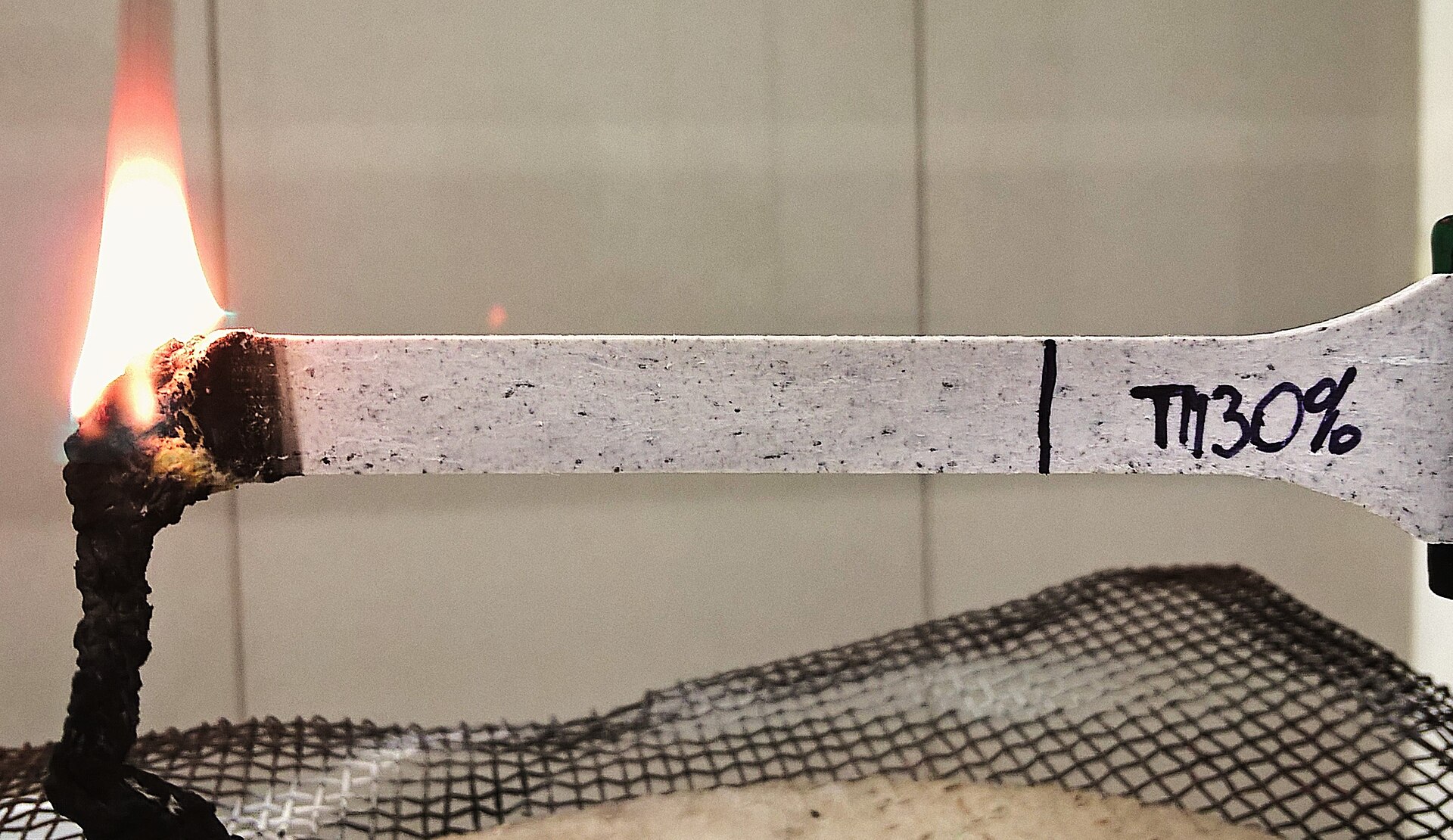
2. Flame retardancy: UL 94 is useful screening data, not airworthiness
UL 94 evaluates the flammability of plastic specimens for parts in devices and appliances. Ratings depend on method, thickness, colour and material construction. UL itself warns that a small-scale UL 94 rating cannot be substituted for unrelated fire requirements. Aviation rules address the material or system in its location and fire threat; FAA 14 CFR 25.853 guidance, for example, links requirements to categories of aircraft interior materials and specified test configurations. EASA’s VTOL special condition addresses fire initiation, propagation and the continued safe outcome of system-level events.
A plastic flame-retardant can be screened only after the base resin, wall thickness, reinforcement, pigment, electrical requirement and target test are defined. Halogen-free is a composition or procurement requirement, not an automatic fire-performance rating. Likewise, a V-0 coupon does not establish low smoke, low toxicity, electrical tracking resistance, battery thermal-runaway containment or aircraft approval.
Flame packages often interact with impact modifiers, glass fibre, pigments, stabilisers and processing aids. Conventional particulate systems may need high loading and can reduce elongation or increase density; reactive or better-compatible research systems demonstrate that trade-offs can sometimes be improved, but a published result for one polymer chemistry cannot be transferred to another formulation by analogy. Measure heat ageing, impact, dielectric properties, corrosion risk, moisture response and process stability alongside the target flame test.
3. Heat, creep and dimensional control are different problems
Low-altitude electronics, batteries, motors, charging units and outdoor cabinets create local heat and repeated temperature cycles. A polymer may keep its tensile strength yet creep under a clamping load, relax a connector force, shrink unevenly after moulding or hydrolyse in humid service. These mechanisms require different tests and sometimes different material solutions.
A heat stabilizer may slow oxidation in a compatible resin, while an anti-warping stabilizer or stiffening-agent route may be screened when dimensional stability is the dominant problem. None repairs hydrolytic chain scission or poor mould cooling. Increasing stiffness can also reduce impact tolerance and move stress into joints or inserts.
Record continuous and peak temperatures, load, duty cycle, humidity, fluid contact, resin moisture, fibre orientation and dimensional tolerances. Compare initial properties with retention after representative ageing. For connectors and sealed housings, torque, insertion force, seal compression and leakage can be more meaningful than a generic heat-deflection number.
4. Compatibilizers and recycled content: circularity requires a controlled interface
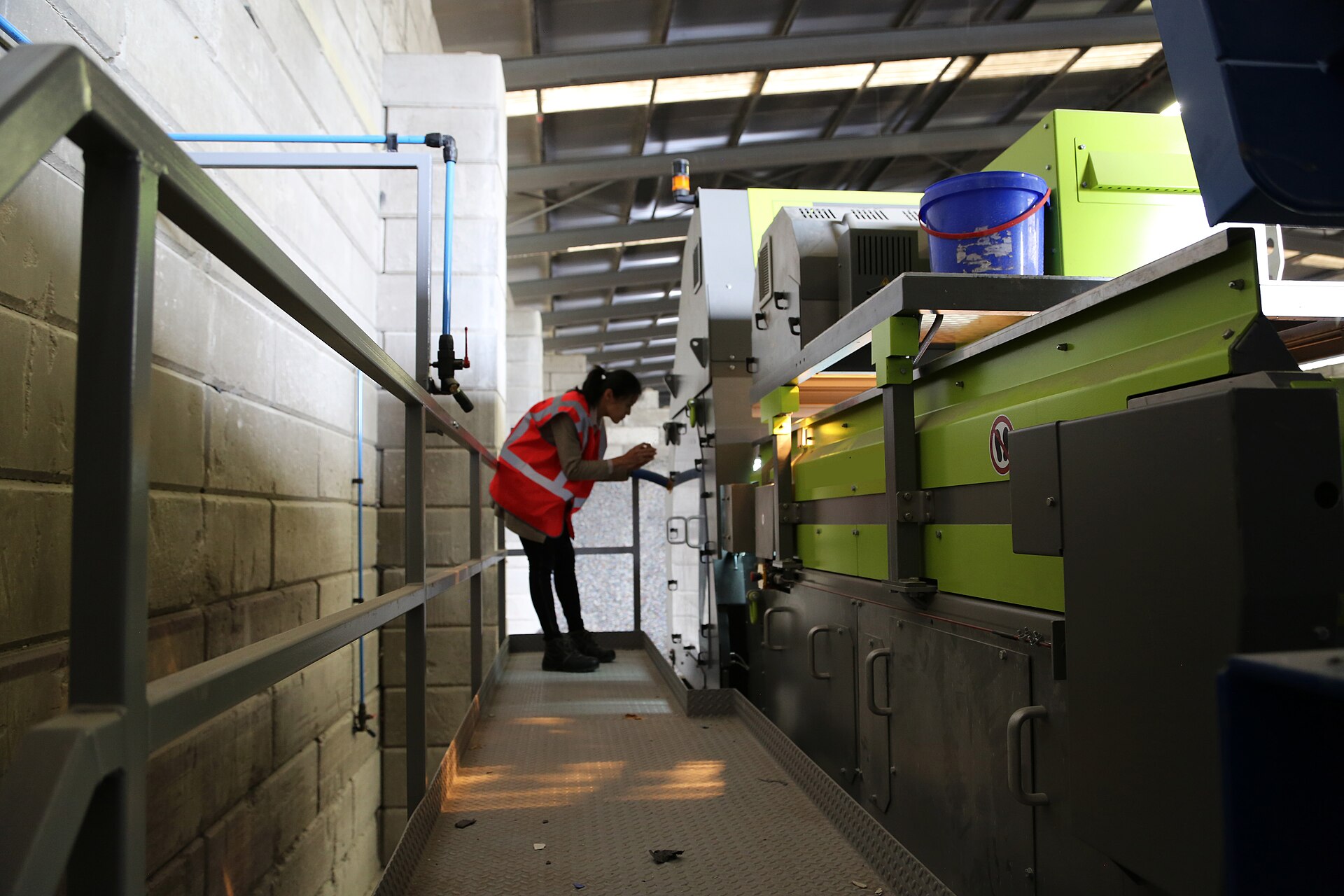
Ground infrastructure and non-critical housings may offer earlier routes for recycled-content compounds than flight-critical structures, but recycled content increases the need for feedstock control. Mixed polymers, fillers, pigments, degradation and moisture can change impact, creep, dielectric behaviour and fire response. A recycled-content claim does not tell the engineer whether the material is stable enough for the intended component.
A plastic compatibilizer can improve phase dispersion and interfacial adhesion in selected blends. It cannot restore molecular weight lost to degradation, remove contaminants or make an unknown stream traceable. The programme should define the matrix phase, contaminant limits, ash, MFR/MFI, moisture, odour and incoming-lot acceptance before dosage optimisation.
For any aviation-related use, change control is crucial. A new recyclate supplier, altered blend ratio or substitute pigment may be a material change requiring re-evaluation. Recycled content should therefore start where the consequence of failure, qualification path and supply consistency are manageable, then expand only after evidence accumulates.
5. Antistatic, conductive, EMI-shielding and insulating are not synonyms
Drones and low-altitude infrastructure combine antennas, navigation, power electronics, batteries, cameras and data links in compact spaces. This creates several electrical material tasks that point in opposite directions. An antistatic agent may reduce surface-charge accumulation and dust attraction, often with sensitivity to humidity, migration and time. EMI shielding generally needs a connected conductive network and an enclosure design that controls seams and apertures. Electrical insulation needs low conductivity, high dielectric strength and stable tracking behaviour.
Carbon-fibre composites can provide useful shielding through reflection, as experimental research has shown, yet anisotropy, joints, coatings and frequency change enclosure performance. Adding conductive carbon to a connector housing that must insulate high voltage could create a serious new failure mode. Conversely, specifying ‘antistatic’ will not establish shielding effectiveness for an avionics enclosure.
Write separate targets for surface resistivity, volume resistivity, charge decay, shielding effectiveness by frequency, dielectric strength, comparative tracking index and grounding architecture. Then assign each target to the correct component zone. The formulation cannot be selected until the electrical function is unambiguous.
6. Flow, moulding and surface quality determine whether the part reaches service
Thin walls, long flow paths, ribs, inserts and short fibres can produce incomplete fill, weld-line weakness, trapped gas, flash, fibre orientation and warpage. A formulation that looks strong on a moulded test bar may fail at a weld line in the real housing. Increasing MFR can improve fill but reduce molecular weight or mechanical retention depending on how the change is achieved.
A melt-flow index modifier may be screened with pressure, torque, residence time and final properties. Plastic matting agents and anti-scratch or slip agents can address selected appearance and handling requirements, but migration, coating adhesion, friction, contamination and optical effects must be reviewed. A cosmetic surface treatment must not interfere with bonding, sensor performance or electrical contact.
Use a process window, not one machine setting. Capture actual melt temperature, mould temperature, injection pressure, fill time, pack, cooling, part mass, dimensions and reject modes. Representative mould trials should include the lowest and highest intended material and process limits.
7. Optical and sensor plastics need wavelength-specific evidence
Navigation lights, status indicators, camera windows, LiDAR or optical sensor covers and diffusers turn appearance into a functional property. A part that looks clear to the eye may block the sensor wavelength, create ghosting, scatter too much light or yellow after ultraviolet exposure. Pigments, flame retardants, impact modifiers, mould texture and wall thickness can all change the optical path.
A light diffusion agent may support uniform illumination, while transparent toughening may protect a cover from impact. These functions are not interchangeable. Measure spectral transmission at the working wavelengths, haze, angular light distribution, colour shift, surface quality and retention after weathering, chemicals and cleaning.
For optical housings, cleanliness and outgassing may matter as much as initial transmission. The additive supplier should ask where the optical surface sits relative to the emitter or sensor and whether the part is sealed, coated, bonded or sterilised before proposing a screening route.
Additive interactions are the real formulation challenge
A low-altitude polymer compound rarely contains one functional additive. It may combine flame retardant, impact modifier, antioxidant, light stabiliser, pigment, lubricant, conductive filler, glass fibre and processing aid. Each addition changes the environment seen by the others. A lubricant can alter dispersion or bonding; an elastomer can affect char; a mineral package can increase viscosity and density; carbon can change heat transfer, colour and electrical behaviour.
The right experimental design therefore starts with a control and changes as few variables as possible. Screen candidate packages at controlled levels, then test interactions deliberately. Review mechanical, thermal, fire, electrical, dimensional, optical and process data as one decision set. Optimising each property in a separate formulation and then combining the winners is unlikely to produce the best complete compound.
Ordinary automotive experience is valuable, but transfer is not automatic. Flight environment, inspection interval, consequence of failure, certification basis, material traceability and allowable change may differ substantially. Automotive qualification can inform hypotheses; it cannot substitute for the aviation applicant’s compliance evidence.
What the additives industry must build beyond a product catalogue
The next industrial step is application engineering. Suppliers need resin-specific screening data, controlled sample preparation, failure analysis and the ability to discuss component requirements without promising certification. Data should include formulation identity, test thickness, conditioning, specimen preparation, process window, lot number and property retention—not only the best initial value.
Documentation is equally important. Technical data sheets should separate typical values from specifications. Safety data, restricted-substance declarations and change-control procedures should be versioned. Where an additive has not been tested in an aviation formulation, the supplier should say so. Honest negative boundaries make the remaining evidence more useful.
Co-development should follow gates: define the component and failure mode; select candidate resin and additive routes; run controlled coupons; verify interactions; mould representative parts; age and test them; then support the customer’s applicable qualification or certification process. The additive maker contributes material knowledge, while the aircraft or equipment applicant remains responsible for design approval and compliance.
- Build repeatable lab compounding and moulding capability with recorded process conditions.
- Develop low-temperature, ageing, flame, electrical, dimensional and optical screening around actual resin systems.
- Use microscopy, rheology and failure analysis to explain results rather than relying on pass/fail claims.
- Establish lot traceability, material-change notification and retained reference samples.
- Train commercial teams to distinguish screening support from certification or guaranteed end-part performance.
A cautious three-to-five-year industry judgement
This is an industry judgement, not a government forecast. Over the next three to five years, the strongest additive demand is likely to come from established unmanned applications, electronics and battery housings, communications and charging infrastructure, and non-flight-critical components where qualification cycles and failure consequences are manageable. These markets still require disciplined testing, but they can scale before routine passenger operations do.
Passenger eVTOL programmes may create higher-value requirements for flame, smoke, toxicity, thermal management, dielectric performance, structural composites and traceability. Their volumes and timing remain less certain because certification, operations, infrastructure, noise, public acceptance and economics must progress together. Material suppliers should participate early without building capacity plans on a single announced launch date.
The competitive advantage will not be the largest list of additives. It will be the shortest credible route from a component failure mode to a documented, reproducible formulation screening result.
Procurement checklist: what to send before a formulation trial
A useful first technical enquiry is compact but specific. It allows the supplier to reject unsuitable routes early and design a small screening matrix instead of sending generic samples.
- Component function, flight or ground location, consequence of failure and current development stage.
- Base resin, grade, reinforcement, pigment, recycled content and known additives.
- Part geometry, minimum and maximum wall thickness, weld lines, inserts, joining and surface treatment.
- Process, drying, temperature profile, residence time, pressure and current reject mode.
- Service temperature, impact temperature, UV, humidity, fluids, vibration, electrical and cleaning exposure.
- Named test methods, target values, conditioning, specimen thickness and applicable certification basis.
- Properties that must not decline: stiffness, flow, dimensions, dielectric behaviour, optics, bonding or appearance.
- Required documentation, restricted-substance limits, traceability and change-notification expectations.
Conclusion: start with a bounded engineering question
China’s low-altitude economy gives the plastics industry a serious opportunity, but it also removes the room for vague additive claims. The winning material route will be the one that identifies the real failure mode, preserves competing functions, survives representative ageing and arrives with traceable evidence.
ARGIOPE® product families are candidates for formulation screening. They do not constitute automatic aviation approval, airworthiness certification or guaranteed performance in a customer’s final component.
To begin a technical discussion, send the component description, resin and reinforcement, process, environment, test target and non-negotiable properties. The first outcome should be a screening plan with explicit limits—not a promise that one additive solves the aircraft.
Questions engineering and procurement teams ask first
Can a UL 94 V-0 plastic be used directly in an eVTOL aircraft?
No. UL 94 is a material flammability classification under defined specimen conditions. The aircraft programme must identify the applicable certification basis, fire threat, component location, thickness and required means of compliance. V-0 may be useful screening data, but it is not airworthiness approval.
Can an automotive additive formulation be transferred to a drone?
It can provide a starting hypothesis, not automatic qualification. Load, vibration, temperature, UV, electrical environment, inspection, failure consequence, traceability and certification can differ. Re-test the complete formulation and representative part for the intended application.
Which additive is most important for low-altitude aircraft?
There is no universal priority. The dominant failure mode may be cold impact, fire, creep, warpage, dielectric breakdown, EMI, flow or optical loss. Define the component and test target before ranking additive families.
Does halogen-free mean aviation-compliant or low-smoke?
No. Halogen-free describes a composition requirement under a defined method or customer specification. It does not automatically establish a flame rating, smoke density, toxicity, corrosion behaviour or aviation compliance.
What is a sensible first sample programme?
Use one resin lot, a control and a small number of technically plausible additive routes at controlled levels. Keep drying and processing fixed, then compare the target property with the properties that must be retained. Advance only the balanced candidates to representative parts and ageing.
Policy, standards and research sources
- State Council of China, 2024 Government Work Report: low-altitude economy identified as a new growth engine.
- State Council of China, 2025 Government Work Report: safe and healthy development of the low-altitude economy.
- NDRC, December 2025 briefing on application maturity and the cargo-before-passengers, segregated-before-integrated, suburban-before-urban principle.
- MIIT, February 2026 meeting on low-altitude industrial safety, standards, manufacturing management and test validation.
- MIIT and four other authorities, 2026 implementation opinion on information and communications support for low-altitude infrastructure.
- CAAC, Interim Regulations on the Flight Administration of Unmanned Aircraft, effective 2024.
- CAAC, 2026 airworthiness standard for normal-category multirotor unmanned aircraft systems.
- EASA, Special Condition for VTOL and Means of Compliance.
- FAA, Flammability Testing of Interior Materials under 14 CFR 25.853 and Appendix F.
- UL Solutions, Standards for Evaluating Plastics and the scope of UL 94.
- UL Solutions, Understanding UL 94 Rating Certifications and Limitations.
- Petrova et al. (2020), combined effects of UV, temperature and moisture on polymer composites in cold climates.
- Zhang et al. (2023), toughening and flame-retardant polypropylene through block-copolymer design.
- Chung (1999), EMI shielding by continuous carbon-fibre polymer-matrix composites.