
Why lightweighting is only the starting point
In an electric vehicle, a polymer part may sit between a live conductor and a passenger, between a hot cell and the next propagation path, or between a stone strike and the battery pack. It may need to hold a connector geometry after thousands of thermal cycles, resist coolant and humidity, survive a low-temperature impact, meet a flame test at a specified thickness, and still be processable at automotive scale.
The base resin cannot do all of that alone. Additives are what turn a polymer into an application-specific material system. They are also where many formulations fail.
The sharp point is this: the future of EV plastics will not be decided by how many functions can be added to a datasheet. It will be decided by how well competing functions are balanced in the finished part.
EV growth is turning material selection into a production issue
Electric vehicles are no longer a niche material-development programme. The International Energy Agency reported that electric cars accounted for roughly one-quarter of new-car sales in 2025 and expects their share to rise further in 2026. As platforms scale, material choices that worked in a pilot run must survive global sourcing, faster moulding cycles, multiple resin grades and years of field exposure.
That changes the question for compounders and component manufacturers. ‘Can this resin pass one test?’ is not enough. The useful question is: can the complete formulation repeatedly pass the relevant tests after processing, ageing, moisture exposure and production variation?
Where plastic additives do the real work
| EV component or area | Additive roles worth screening | What must be verified |
|---|---|---|
| Charging plugs, sockets and high-voltage connectors | Flame retardant, heat stabilizer, impact modifier, anti-warping support | Part-thickness flame test, dielectric performance, tracking resistance, heat ageing, insertion cycles |
| Battery module holders and electrical covers | Flame retardant, impact modifier, stiffening or dimensional-control package | Fire performance, impact after ageing, shrinkage, warpage, assembly fit |
| Battery pack housings and underbody shields | Toughening, compatibilizer or coupling support, flame-retardant system, processing aid | Puncture, fire barrier performance, creep, water uptake and complete compound behaviour |
| Cooling-system clips, ducts and fluid-contact parts | Heat and hydrolysis stabilization, impact modification | Fluid ageing, burst or fatigue behaviour, dimensional retention |
| Sensor covers, lighting parts and display surrounds | Transparent impact modifier, light diffusion agent, UV and surface package | Haze, transmittance, yellowing, weathering, impact and surface appearance |
| Recycled interior and non-safety-critical compounds | Compatibilizer, impact modifier, stabilizer, MFI adjustment | Lot composition, VOC/odour, mechanics, MFR, colour and ageing |
1. Flame retardancy: a rating is not a formulation
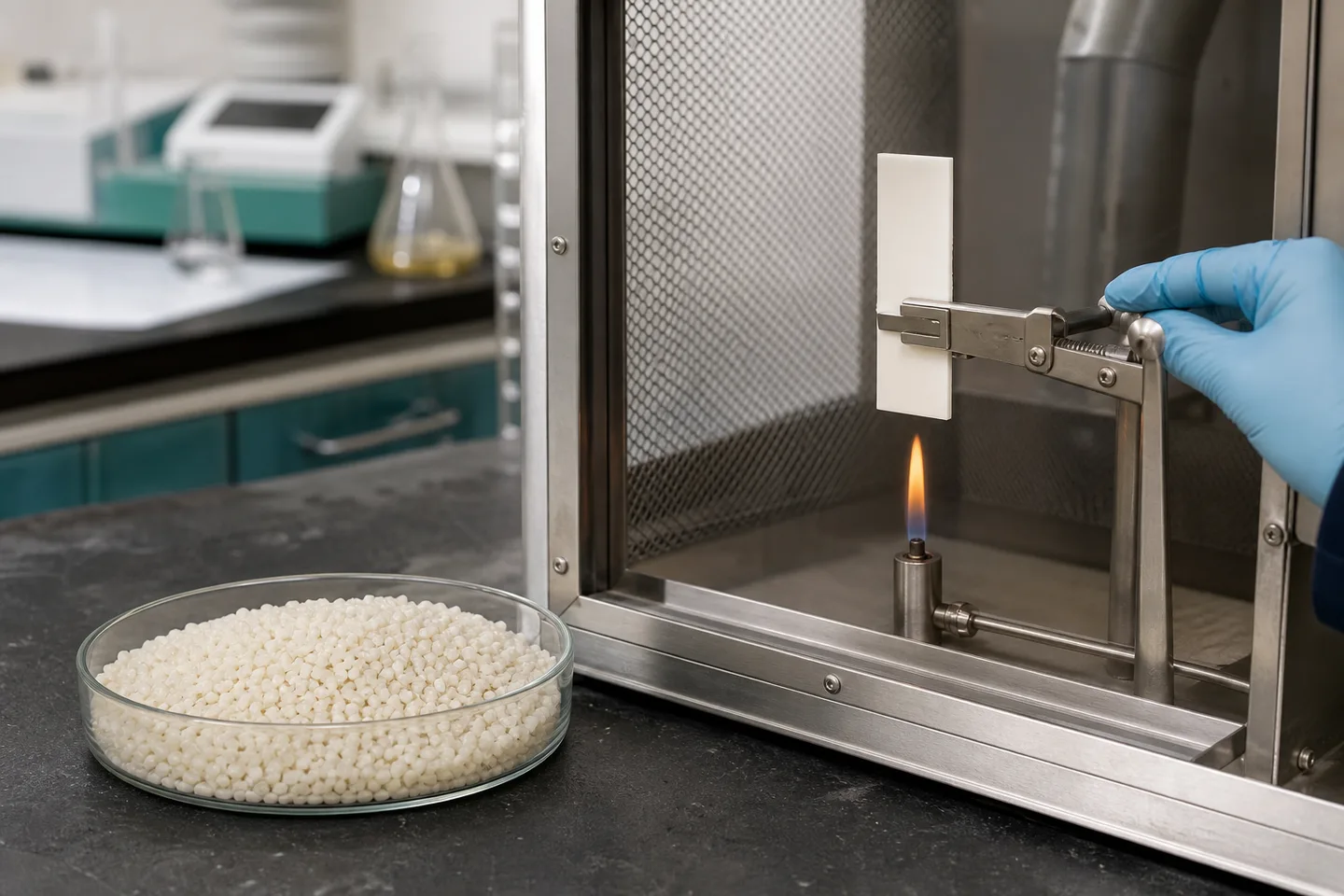
Flame retardants are central to EV connectors, electrical covers, charging equipment and selected battery components. Yet ‘V-0 material’ is one of the most misleading shortcuts in polymer procurement.
UL 94 classifications depend on specimen thickness and test configuration. Glow-wire methods evaluate a different ignition scenario. A battery enclosure faces heat flux, mechanical load and possible thermal-runaway exposure that cannot be represented by a small vertical-burning bar alone. UN Regulation No. 100 also treats the rechargeable energy storage system as a safety system, not as a collection of independently qualified plastic coupons.
A flame-retardant package can improve ignition resistance while reducing impact strength, elongation, melt flow or surface quality. High filler or flame-retardant loading may also increase density and tool wear—the opposite of what an EV lightweighting project intended to achieve. Some systems change colour, absorb moisture or interact with glass fibre and pigments.
ARGIOPE® plastic flame-retardant solutions can be screened for suitable resin systems, but final performance must be confirmed in the buyer’s complete formulation and part geometry.
- Define the exact fire test and target classification.
- Confirm the minimum wall thickness in the real part.
- Record the base resin, reinforcement, pigment and recycled content.
- Verify impact, electrical and heat-ageing performance after conditioning.
- Check smoke, halogen and market-specific chemical restrictions separately.
2. Toughness: the cold part usually exposes the weak formulation
Battery covers, underbody parts, cable-management components and connector housings must tolerate assembly stress, vibration and impact. Low temperature makes this harder because many polymers lose ductility as molecular mobility decreases.
An impact modifier or anti-cold additive may improve crack resistance and elongation, but toughening is never free. Too much soft phase can reduce stiffness, heat-deflection performance or dimensional accuracy. In reinforced compounds, the wrong modifier may weaken the fibre–matrix interface. In flame-retardant compounds, it may increase combustible content or disturb char formation.
The engineering target should therefore be the lowest-temperature, post-ageing performance of the finished part, not an attractive room-temperature impact value on a fresh sample. A disciplined trial compares impact, tensile or flexural behaviour, heat performance and shrinkage together. If one number rises while three critical properties fall, the formulation has not improved.
3. Heat stabilization: EVs remove the engine, not the heat problem
Electric powertrains redistribute heat rather than eliminate it. Fast charging, power electronics, busbars, motors and cooling loops create local hot zones and repeated thermal cycles. PA, PBT, PET, PP, PC and their blends respond differently to heat, oxygen, moisture and coolant exposure.
Heat stabilizers can slow oxidation or help retain dimensions in selected systems, but the degradation mechanism must be identified first. A hydrolysed polyester does not recover because more impact modifier was added. An oxidised polyolefin is not repaired by a compatibilizer. Moisture-sensitive engineering plastics require controlled drying before any additive comparison is credible.
For EV components, ageing work should reproduce the likely combination of temperature, time, humidity, fluid contact and mechanical stress. Short oven ageing at one temperature may miss hydrolysis, stress cracking or property loss under cycling.
4. Compatibilizers: the circularity claim lives or dies at the interface
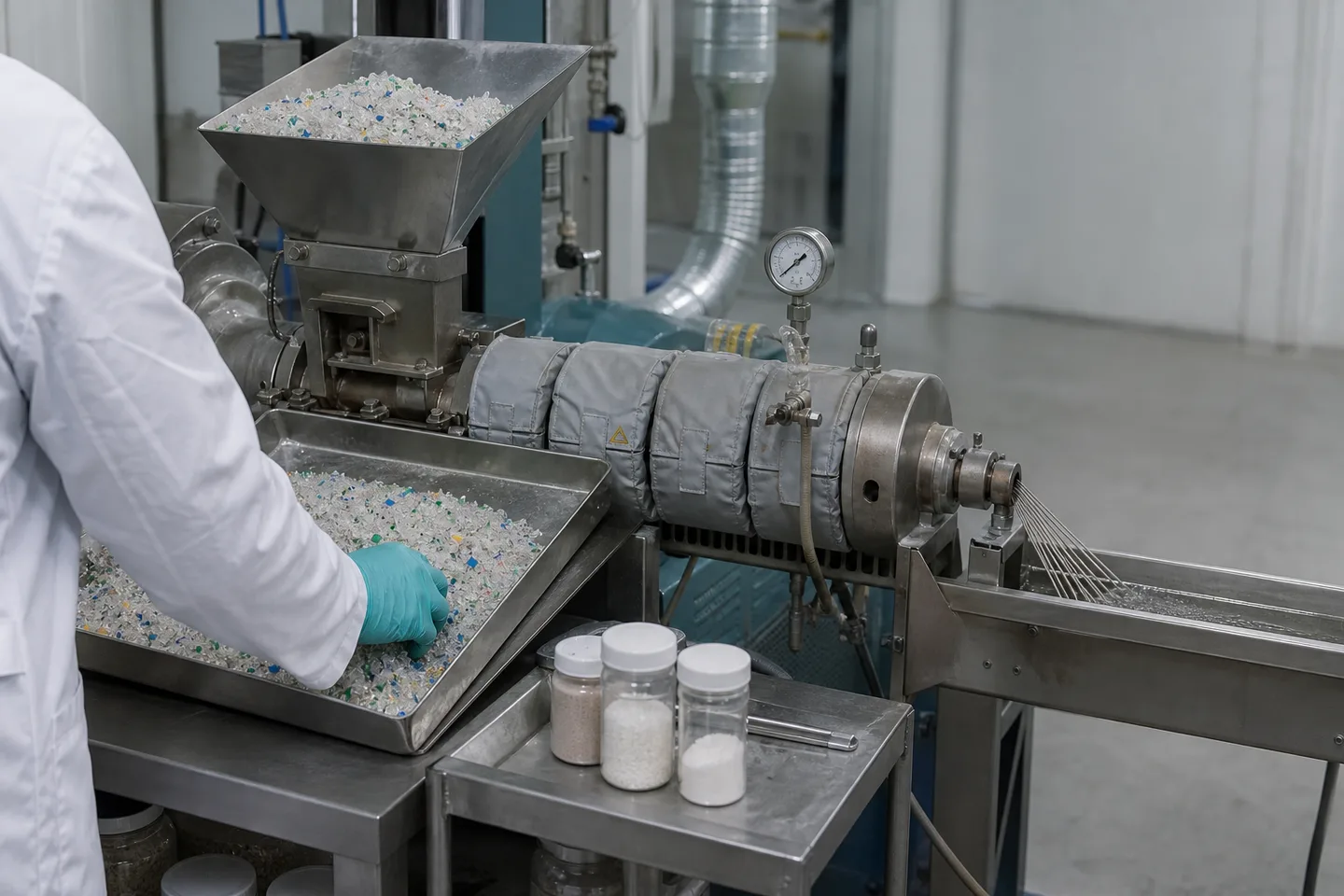
Automotive manufacturers want more recycled content, but recycled plastics arrive with variation: different polymer grades, pigments, fillers, degradation histories and trace contaminants. Mixing them does not automatically create a useful automotive compound.
A plastic compatibilizer can reduce interfacial tension, refine phase size and improve stress transfer in a mismatched blend. It may also help a filled or fibre-reinforced compound achieve a better toughness–stiffness balance. But there is no universal ‘recycled plastic compatibilizer.’ Chemistry that works for a PP-rich blend may do little for a polyolefin stream contaminated with PET or PA.
The uncomfortable truth is that an additive cannot correct poor feedstock control indefinitely. If the incoming composition changes faster than the formulation can tolerate, the real problem is sorting and specification—not additive dosage.
Before a recycled automotive trial, record polymer composition, ash or filler content, MFR/MFI, moisture, odour, colour, filtration pressure and prior thermal history. Then compare the control and candidate formulations under the same conditions. Mechanical data, rheology and process observations should tell the same story.
5. Static control and EMI shielding are not the same job
EVs contain more electronics, sensors and high-voltage hardware than conventional vehicles. This creates demand for static control and electromagnetic-interference management—but the terms are often mixed together.
An antistatic additive may reduce surface charge and dust attraction. Its effect can depend on humidity, migration and service time. EMI shielding usually requires a conductive network formed by carbon, metal or another functional filler. Electrical insulation requires the opposite behaviour.
Using ‘conductive’ as a general mark of advanced performance is dangerous. A battery connector housing may need very high insulation resistance, while a neighbouring electronics enclosure may need controlled conductivity for shielding. Additives must be zoned by function, and volume resistivity, surface resistivity, dielectric strength and tracking behaviour should be treated as separate measurements.
6. Flow and warpage: production rejects can erase the material gain
EV parts are becoming thinner, more integrated and more geometrically demanding. A formulation can pass laboratory tests and still fail commercially because it does not fill a long flow path, traps gas, flashes, warps or misses an assembly tolerance.
Melt-flow adjustment and anti-warping support may help selected PP, PE and other systems, but they cannot compensate for every mould problem. Gate position, fibre orientation, packing, cooling and local wall thickness frequently dominate warpage.
The formulation and process must be developed together. Record actual melt temperature, mould temperature, injection pressure, cycle time, shrinkage and post-mould dimensions. ‘Same machine settings’ are not enough if two formulations produce different melt temperatures or pressures.
7. Optical additives are becoming functional, not decorative
Ambient lighting, illuminated charging indicators, sensor windows and display-adjacent parts are expanding the optical role of plastics inside and outside the vehicle. Here, transparency alone is not the target.
A transparent part may need controlled haze, uniform diffusion, low yellowing, impact resistance and weathering stability. A transparent impact modifier can support toughness in compatible resin systems, while a light diffusion agent can distribute light more evenly. The two functions should not be confused: one manages mechanical failure; the other manages the path of light.
Optical trials should measure total transmittance, haze, colour shift and ageing—not rely on visual judgement alone. For sensor covers, spectral transmission at the working wavelength matters more than a clear appearance under room light.
The formulation trap: adding functions until the polymer loses its balance
EV plastics invite additive stacking: flame retardant, toughener, heat stabilizer, pigment, release agent, conductive filler and recycled content in one compound. Each ingredient may be technically justified. The package can still fail because additives interact.
The solution is not to avoid multifunctional materials. It is to use a test matrix that exposes the conflicts early. One-factor-at-a-time trials are often too slow and can miss interactions. A small design-of-experiments programme is more useful when several additives are expected to work together.
- Flame retardancy versus impact strength and flow.
- Conductive filler versus electrical insulation.
- Stiffness versus low-temperature toughness.
- Recycled content versus odour, colour and lot consistency.
- Light diffusion versus total transmission.
- Improved flow versus molecular-weight retention.
- High filler loading versus warpage, surface quality and tool wear.
What changes next: higher-voltage platforms reduce the margin for error
Faster charging and higher system voltage increase attention to creepage, clearance, tracking, dielectric ageing and heat around connectors and power electronics. Polymer formulation, moulded geometry and contamination control will need to be considered as one electrical-insulation system.
Fire protection will move from a single rating to event management
Future battery materials will be judged not only by whether they ignite, but by how they delay heat transfer, maintain structural integrity, limit propagation and manage smoke. Recent battery-enclosure research already combines flame retardancy with thermal-barrier and mechanical performance. A high flame rating with a weak, collapsing char may be less useful than a balanced structure that stays in place during the critical event.
Recycled thermoplastics will enter more demanding applications—but slowly
European research programmes are developing recycled fibre-reinforced thermoplastics for battery housings and automotive components. The direction is credible. The qualification burden is also real: feedstock control, ageing, fire performance, repair, traceability and end-of-life separation must all work at scale.
Halogen-free and low-migration systems will face closer scrutiny
‘Halogen-free’ is a useful purchasing requirement, not a complete safety or environmental assessment. Future formulations will be compared on smoke, toxicity, migration, persistence, recyclability and property retention as well as flame performance. Suppliers that can only offer a label will struggle; suppliers that can explain the mechanism and trade-offs will remain relevant.
Data-driven formulation will become normal, but testing will not disappear
Machine learning can narrow a formulation window, identify interactions and connect processing data with final properties. It cannot rescue poor input data or replace a required compliance test. The best use of modelling is to reduce unnecessary experiments, then confirm the selected formulation under production-representative conditions.
A practical qualification checklist
Before requesting an additive recommendation for an EV project, prepare the following information. It prevents the most expensive formulation mistake: solving the wrong problem.
- Base polymer, exact grade and supplier.
- Reinforcement, mineral filler, pigment and recycled-content level.
- Part function, minimum wall thickness and drawing-critical dimensions.
- Process route, equipment and realistic temperature window.
- Target flame, glow-wire, electrical, impact, heat and environmental tests.
- Lowest and highest service temperature.
- Required ageing, humidity, UV, coolant, oil or cleaning-fluid exposure.
- Current failure mode and control-formulation data.
- Colour, gloss, haze, odour or VOC limitations.
- Regulatory market and required documentation.
The real opportunity for additive suppliers
The electric-vehicle market does not need another catalogue claiming that one additive improves everything. It needs suppliers who can translate a part failure into a controlled material trial, admit where properties conflict and help customers verify the final formulation.
ARGIOPE® Jindaquan supplies functional additive families for flame retardancy, impact modification, compatibility, thermal stability, static control, optical performance and dimensional support. These product families are candidates for application screening, not automatic automotive approvals. Grade selection should begin with the resin, part thickness, process, failure mode and target test.
For a focused technical discussion, send the base resin, formulation, component use, processing conditions and required performance. A small, well-designed trial is more valuable than a large additive claim.
Frequently asked questions
Does using an EV additive make a polymer automotive-grade?
No. An additive family can be a candidate for application screening, but the customer must validate the complete resin, formulation, wall thickness, process, ageing condition and target tests.
Can one additive package solve flame, impact and warpage together?
Sometimes one package influences several properties, but interactions are common. Treat flame, mechanics, flow, dimensions and ageing as a balanced test matrix rather than assuming every property will improve.
Is a UL 94 V-0 classification enough for a battery enclosure?
No. UL 94 is thickness- and configuration-dependent and does not reproduce the complete thermal, mechanical and propagation conditions of a battery system.
When should a compatibilizer be considered for recycled automotive plastics?
Consider it when mismatched polymer phases, poor interfacial adhesion or unstable dispersion limit processing or mechanical performance. Feedstock composition and moisture still need to be controlled first.
Which information should be supplied before an EV formulation trial?
Provide the exact resin and grade, fillers, recycled content, part thickness, process window, failure mode, service conditions and required fire, electrical, mechanical and environmental tests.
References and further reading
- International Energy Agency, Global EV Outlook 2026.
- UNECE, UN Regulation No. 100, Revision 3.
- UL Solutions, Standards for Evaluating Plastic Products.
- IEC 60695-2-13:2021, Glow-Wire Ignition Temperature Test Method.
- Recent Advances in Battery Pack Polymer Composites, Energies (2023).
- Flame-Retarded Glass-Fiber Polypropylene for EV Battery Enclosures, Fire Safety Journal (2026).
- European Commission CORDIS, RESiLiTE Recycled Thermoplastic Battery Housing Project.
- European Commission CORDIS, REVOLUTION Recycled Plastics for Automotive Components.