
Get Technical Advice
Back to Opaque impact modifierOpaque impact modifier
A-669K
Broad-compatibility toughening granule for flexible and mixed polymer systems
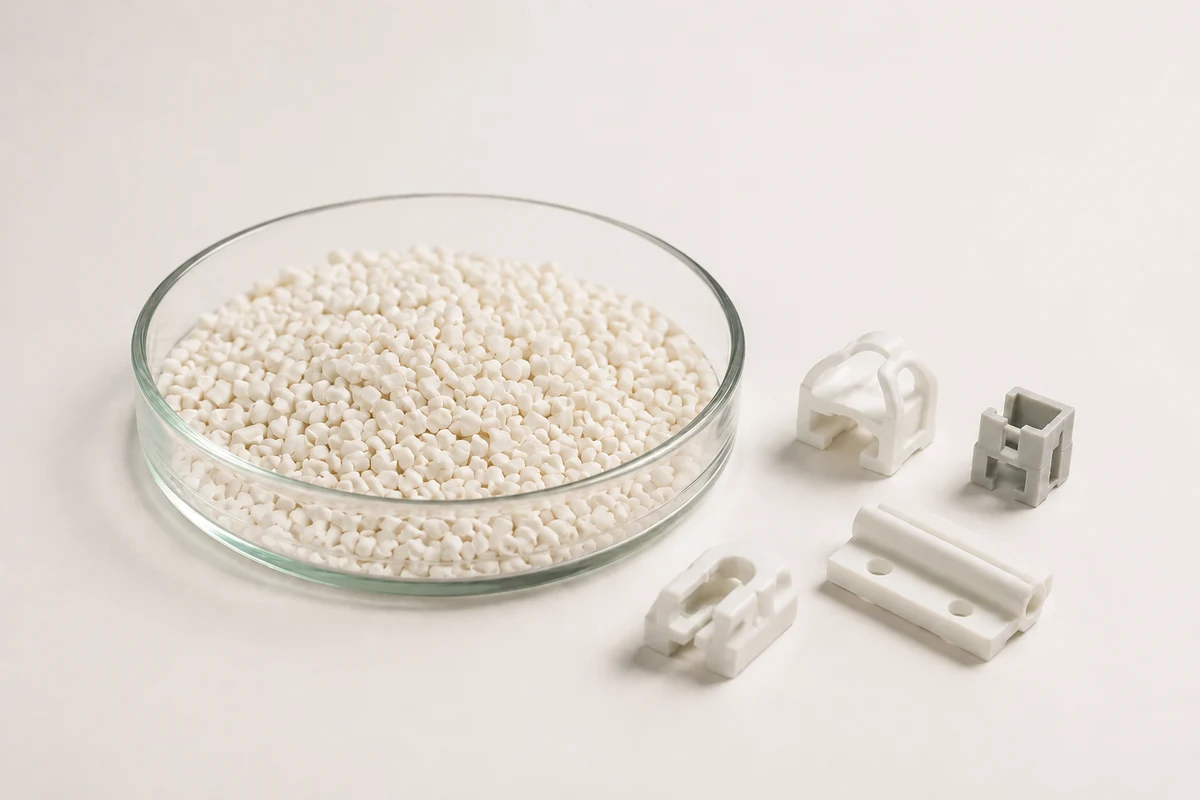
A-669K is a 100% active granule listed for PP, PE, PVC, TPU, EVA, TPE and PU trials. It is positioned for formulations that need stronger interfacial compatibility, elongation, impact response, tear resistance and low-temperature toughness.
25 kg paper-poly pouch
TDS-derived technical profile
Key values listed for A-669K
The following technical values are taken from the current TDS to support grade selection and initial formulation work.
| Property | Listed value |
|---|---|
| Effective substance content | 100% |
| Density | 0.9 g/cm³ |
| Melt flow rate | 0.6 g/10 min |
| Hardness | 78 Shore A |
| Vicat softening temperature | 50°C |
| Brittle temperature | −69°C |
| Melting point | 152°C |
| Tensile strength | 10.1 MPa |
| Elongation at break | 795% |
| Ash | 0% |
What this grade is positioned to support
- Compatibility support across PP / PE / PVC / TPU / EVA / TPE / PU
- Elongation, impact and tear-resistance evaluation
- Controlled small-batch processing trial
How to prepare the first evaluation
- 01
Blend the grade with the selected resin for 5–8 minutes before processing.
- 02
Keep resin grade, ratio, moisture, temperature and specimen geometry consistent between control and modified samples.
- 03
Measure the stabilized specimens after at least 24 hours and calculate uplift against the matched control.
Why this model is a separate evaluation route
A-669K is the broadest multi-resin route in this batch. The TDS lists PP, PE, PVC, TPU, EVA, TPE and PU together with 795% elongation at break and a -69°C brittle temperature.
What the source document does not establish
- Treat the listed polymers as separate evaluation routes rather than evidence that one formulation transfers unchanged between resins.
- Glass fibre can alter the stated modification effect; compare the same base resin and reinforcement level.
- Use flat, non-porous specimens where possible and compare them after at least 24 hours.
Technical documentation
Request current TDS Current TDS and application guidance
Source file: a-669k-tds.pdf. Use the current TDS values and the listed 2-4% starting range when preparing the first resin trial.